
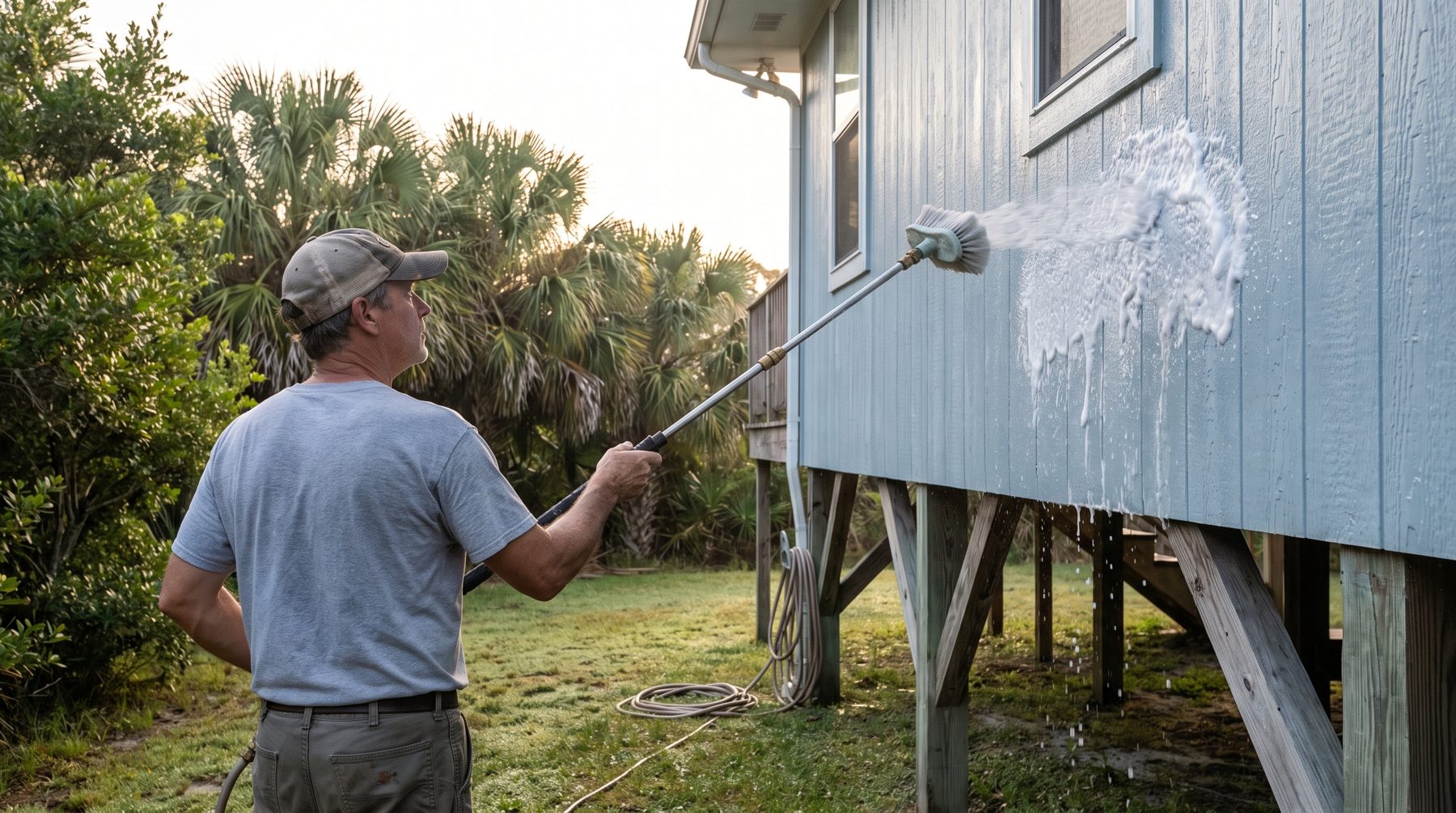
Soft washing vs pressure washing before you paint
Washing is the first coat nobody sees. Too little and mildew grows through the new paint; too much pressure and you damage the wood, the mortar or the siding you are trying to protect.
- Surface-by-surface table
- Mildew and drying times
- 8 minute read
On the coast, almost every exterior repaint starts with a wash. Pollen, salt, dirt and mildew all sit on the surface, and paint applied over them does not bond the way it should. Sherwin-Williams’ Emerald Exterior data sheet is blunt about mildew: it must be removed before painting, or it will grow through any new coat of paint.
The question is how to wash. “Soft washing” and “pressure washing” get used as if they were rival products, but they are really two ends of one decision: how much pressure, and how much cleaning solution, the surface in front of you can take.
Key takeaways
- There is no official definition of soft washing. In practice it means low pressure plus a cleaning solution, close to the method the asphalt roofing industry recommends for shingles.
- High pressure can erode wood, abrade masonry and mortar, and drive water behind siding. Pressure has to match the surface.
- Mildew must be removed before painting. Sherwin-Williams gives a bleach-and-water method with a 48-hour dry.
- Let a washed house dry at least 24 to 48 hours before painting, longer after mildew treatment or heavy rain.
- Pressure washing is allowed on pre-1978 homes under the EPA rule, but the work area and the wastewater must be contained.
What the two terms actually mean
Pressure washing uses a high-pressure stream of water to blast dirt and loose material off a surface. Soft washing is a trade term rather than a defined standard. In practice it means applying a cleaning solution at low pressure, letting it work, and rinsing gently. The closest thing to an authority is the Asphalt Roofing Manufacturers Association, whose algae guidance says the solution should be gently dispersed on the roofing surface and warns, in capitals, not to use a power washer on shingles.
Neither method is always right. The answer depends on what the house is made of, its age, its condition and what is growing on it.
Why pressure is the variable to respect
The National Park Service’s Preservation Brief on cleaning historic masonry warns that water at too high a pressure, a practice common to power washing and water blasting, is very abrasive, and that mortar joints, especially lime mortar, can be eroded by abrasive or mechanical cleaning. It recommends starting at low pressure, 100 psi or below. For a peninsula house with old brick and soft lime mortar, that is the whole argument for a gentle method.
Wood is vulnerable too. The USDA Forest Products Laboratory notes that high-pressure water can erode the wood as well as strip the paint. And lap siding of any material can take water behind it. Sherwin-Williams’ surface preparation FAQ advises allowing the water that is driven up behind the siding to work its way out before painting, and the Vinyl Siding Institute recommends keeping the stream at eye level and pointed straight at the siding, not angled up under the laps.
Mildew must be removed before painting, or it will grow through any new coat of paint.Sherwin-Williams, Emerald Exterior product data sheet
There is a counterpoint worth knowing. For some tough modern substrates, Sherwin-Williams’ professional guidance prescribes real pressure: its pro tips call for pressure cleaning fiber cement with a minimum of 2,100 psi before coating. So the right answer is not “never pressure wash”. It is “match the method to the surface”.
| Surface | Usual approach | Watch for |
|---|---|---|
| Historic brick and lime mortar | Gentle: start at 100 psi or below, with a suitable cleaner | Eroded joints and a roughened brick face |
| Painted wood siding and trim | Low pressure with cleaner, then rinse | Raised grain, gouges, water behind laps |
| Fiber cement siding | Pressure cleaning per the coating maker’s instructions | Water driven behind boards; let it drain and dry |
| Vinyl siding | Moderate, stream straight at the wall, never angled up | Water forced behind panels |
| Wood decks | Low pressure and a deck cleaner | Furred, splintered boards that then need sanding |
| Roof shingles | Low-pressure solution only, per ARMA | Granule loss from any power washer |
Mildew: the Lowcountry problem
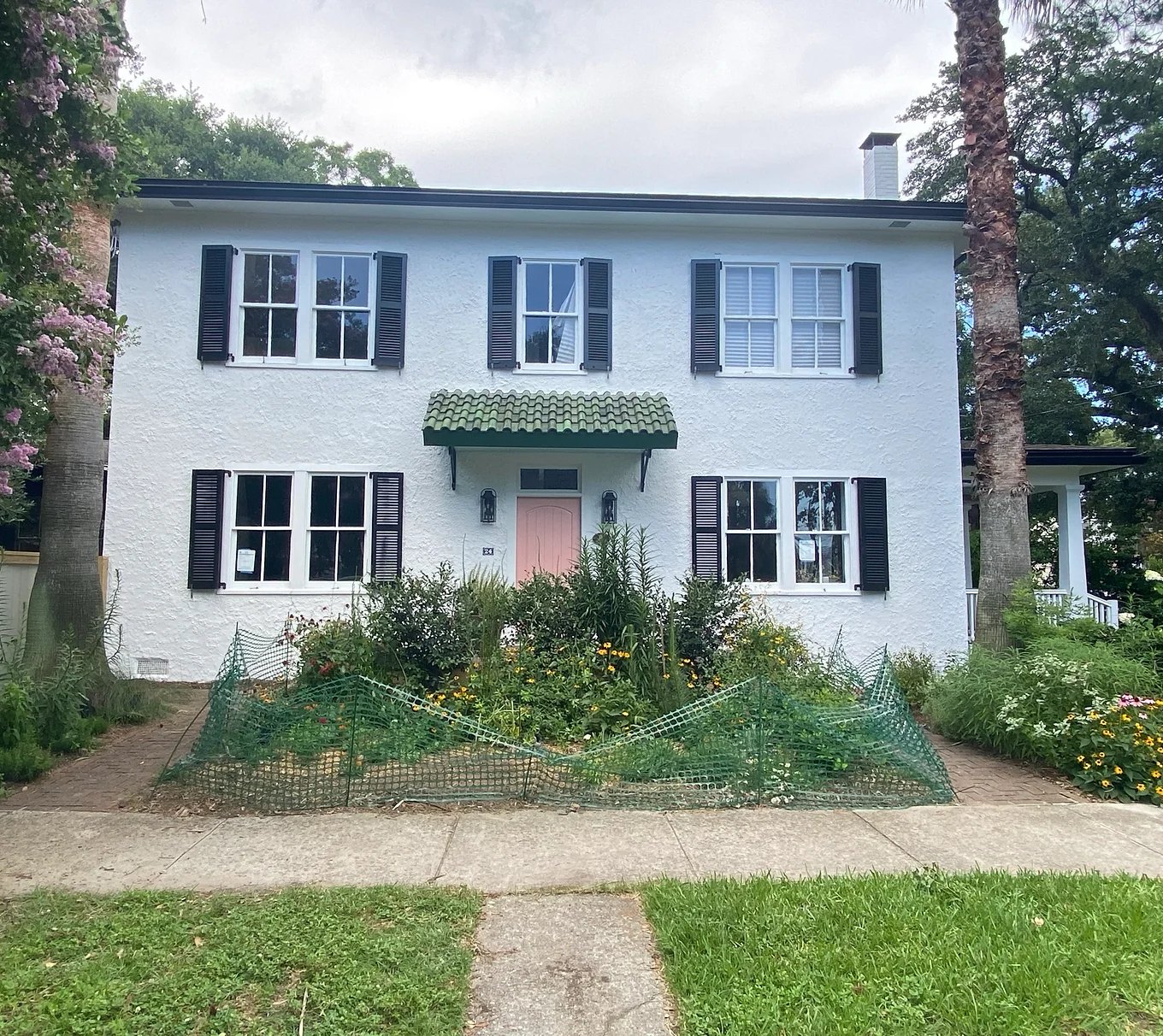
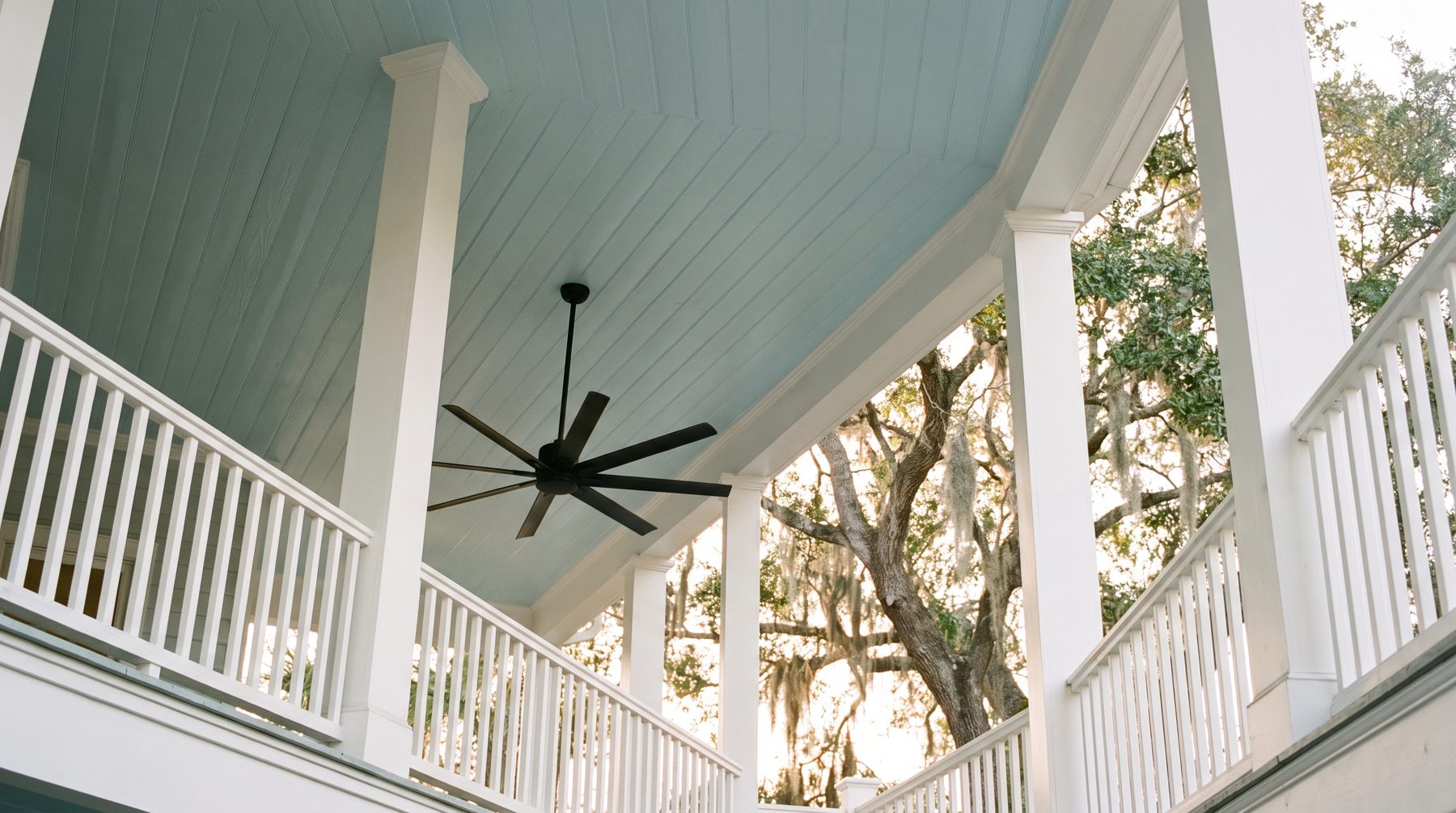
The USDA Forest Products Laboratory observes that mildew fungi grow most extensively in warm, humid climates, which is a fair description of a Charleston August. Shaded walls, porch ceilings and the north side of the house are the usual places it shows first, as grey or black specks that come back after a plain rinse.
Sherwin-Williams’ professional guidance for mildew is a solution of one part household bleach to three parts water, left on for about ten minutes and then rinsed, with the surface allowed to dry for 48 hours before painting. Its FAQ adds: never add detergents or ammonia to the bleach and water solution. The USDA’s research note gives a different recipe that does include a household detergent: about a third of a cup of detergent, a quart of bleach and three quarts of warm water. Pick one method and follow it exactly, protect and rinse plants, and never mix bleach with ammonia.
How long to wait before painting
Sherwin-Williams’ exterior how-to says to allow at least 24 to 48 hours for the house to dry before painting, and its mildew guidance asks for 48 hours after treatment. On the coast, add time after heavy rain, on shaded elevations and wherever water may have been driven behind siding. A dry surface also has to stay dry while the paint cures, which is why the forecast matters as much as the wash. Our post on the best time to paint an exterior in Charleston covers the dew point and rain rules.
Pre-1978 homes, lead and the wash water
Many Charleston houses were painted long before lead paint was banned. The EPA’s Renovation, Repair and Painting FAQ is clear that pressure washing is not a prohibited practice under the rule, but on a regulated job no dust or debris, including in the wastewater, may leave the work area, and landscaping fabric is not an impermeable material. The same FAQ notes that simply washing walls before painting likely would not disturb a painted surface.
In the City of Charleston’s historic districts there is a further line. The Board of Architectural Review guidelines say disc sanding, sandblasting or open flame is never permitted for paint removal. Gentle methods are the starting point there for good reason.
Doing it yourself, or handing it over
Plenty of homeowners rent a pressure washer for a weekend. If you do, start at the lowest setting and the widest tip, keep the wand moving and the stream level, and stay well back from window seals, light fixtures and soft wood. Never point it up under siding laps, never use it on roof shingles, and keep bleach solutions off plants and away from anything containing ammonia. Ladders and wet decks are where most of the risk lives, so keep high work for people with the right equipment.
Hand it over when the house is older, the walls are high, the brick is soft, or the wash is the first step of a repaint. In that last case the person washing should know what comes next, because the wash and the paint are one job: the surface has to be clean, intact and dry on the day the first coat goes on.
What to tell your painter before the wash
- What the walls, trim, decks and roof are made of, if you know.
- Roughly when the house was built, especially if it is before 1978.
- Where mildew keeps coming back: porch ceilings, shaded walls, the north side.
- Plants, fixtures and outdoor furniture that need protecting or moving.
- Whether the wash is a refresh or the start of a repaint, and when you hope to paint.
Washing as part of a Palmetto repaint
Palmetto lists pressure washing for home exteriors, decks and paint preparation, and the right pressure for each surface is part of the scope conversation. Tell us what the house is made of, roughly when it was built, where mildew shows and whether you are washing to refresh or washing to repaint. See how that looks on an older house in Downtown Charm, and if you are planning a deck at the same time, our deck stain guide explains why a clean, dry board is the start of every finish.
Questions
Is soft washing better than pressure washing?
Neither is always better. Soft washing, low pressure with a cleaning solution, is gentler on old brick, mortar, wood and roofs. Some modern surfaces such as fiber cement are routinely pressure cleaned. Match the method to the surface.
Should I pressure wash my house before painting?
The house should be cleaned before painting, and mildew must be removed. Whether that is done with high pressure or a gentler wash depends on the siding, its age and its condition.
How long after washing can I paint?
Sherwin-Williams advises at least 24 to 48 hours of drying, and 48 hours after a mildew treatment. Allow longer on shaded walls, after rain or where water may be behind siding.
How do I get rid of mildew before painting?
Sherwin-Williams’ professional guidance is one part bleach to three parts water, about ten minutes of dwell time, a thorough rinse and 48 hours to dry. Sherwin-Williams says never to add detergents or ammonia to that solution. Protect and rinse plants.
Can you pressure wash a house built before 1978?
Yes. The EPA says pressure washing is not prohibited under its lead rule, but on regulated work the area must be contained so no debris, including wastewater, leaves it.
Does Palmetto offer pressure washing on its own?
Palmetto lists pressure washing for home exteriors, decks and paint preparation. Ask for it on its own or as the first step of a repaint.
Sources
- National Park Service: Preservation Brief 1, cleaning masonry
- Sherwin-Williams: Exterior surface preparation FAQs
- US EPA: RRP program FAQ (January 2026)
- USDA Forest Products Laboratory: mildew research note
Also consulted: Asphalt Roofing Manufacturers Association on algae discoloration; Sherwin-Williams Emerald Exterior data sheet, “Know Your Substrate” pro tips and exterior how-tos; Benjamin Moore Aura Exterior data sheet; USDA Agriculture Handbook 647; Vinyl Siding Institute (2014); City of Charleston BAR General Guidelines (2024). Sources read 30 September 2026.
01 / Keep reading
More from the notebook.
Posts and guides for Lowcountry homeowners.

02 / Your next chapter
Tell us about the house.
A conversation, a free onsite estimate and a scope in writing. No pressure to decide on the spot.
843.998.1649 info@palmettopaintingcontractors.com