
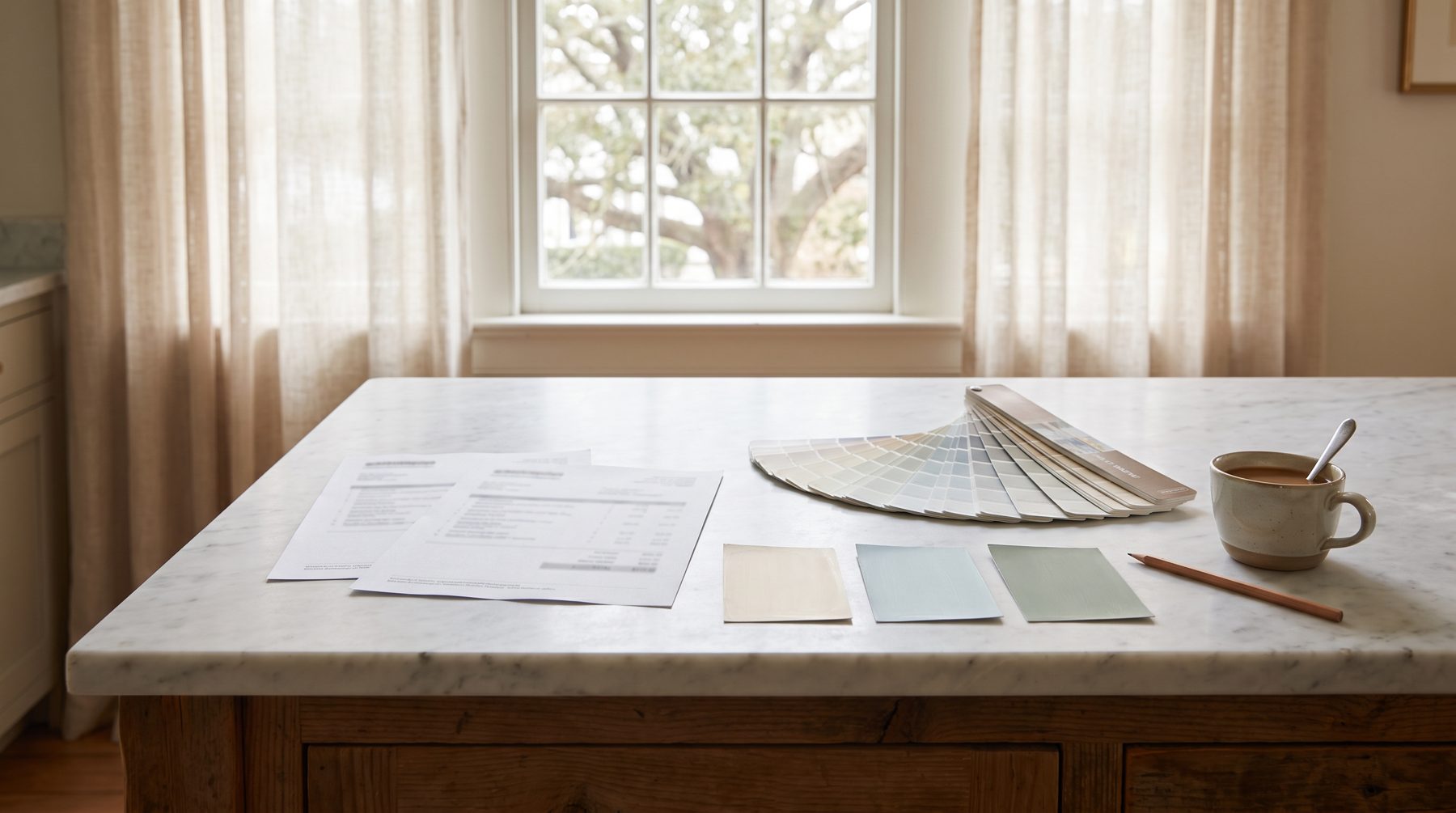
What it costs to paint a house in Charleston, and how to compare estimates
National averages give you a starting range. Your house, its age, its access and the scope written on the estimate decide the real number. Here is how to read the difference.
- National figures labelled
- Estimate comparison table
- 9 minute read
The first question almost everyone asks a painter is how much. The honest answer is that a written number only means something once you know what it covers. Two estimates for the same house can differ by thousands because one includes the trim, the porch ceiling and the repairs, and the other does not.
This post gives you the national averages so you have a frame of reference, then the things that move a Charleston price up or down, the legal points that apply to older Lowcountry homes, and a table you can use to line two or three estimates up side by side.
Key takeaways
- Angi’s national averages, updated July 2026, are about $3,177 for an exterior repaint and $2,022 for an interior. They are national figures, not Charleston quotes.
- Scope, surface condition, access and height move the price more than square footage alone.
- Homes built before 1978 bring the EPA lead-safe rules into play for paid work that disturbs paint.
- In South Carolina, painters register as residential specialty contractors for jobs over $500. Check the registration with SC LLR.
- Compare estimates line by line: surfaces, preparation, products and colours, exclusions, timing and payment terms.
The national numbers, and what they leave out
Angi publishes the most widely quoted cost guides. Its exterior guide, updated 20 July 2026, puts the national average for painting the outside of a house at $3,177, with most homeowners paying between $1,819 and $4,551, and a cost of about $1.50 to $4 per square foot. Its interior guide, updated 9 July 2026, puts the average at $2,022, with a total range of $350 to $5,800 and about $2 to $6 per square foot.
| Project | National average | Typical or full range | Per square foot |
|---|---|---|---|
| Exterior repaint | $3,177 | $1,819 to $4,551 typical | $1.50 to $4 |
| Interior repaint | $2,022 | $350 to $5,800 full range | $2 to $6 |
Those numbers are a sanity check, not a quote. They blend small ranch houses with large two-storey homes, simple repaints with heavy preparation, and every region in the country. A raised Lowcountry house on pilings, with a double piazza, a porch ceiling and shutters, is not the average house in that data. Neither is a 1920s peninsula home with layers of old paint.
What moves a Charleston price
| Factor | Why it changes the price | What to ask |
|---|---|---|
| Surfaces included | Body only is a different job from body, trim, doors, shutters, porch ceilings and railings | Which surfaces are listed, one by one? |
| Condition and preparation | Peeling, failed caulk, mildew and bare wood all take time before any paint goes on | What preparation is included, and what is a separate repair? |
| Height and access | Raised homes, second-storey piazzas and tight side yards may need lifts or extra setup | How will the painter reach the high areas? |
| Number of colours | Each extra colour means more cutting in and more product | How many colours does this price assume? |
| Products and sheen | Premium lines cost more per gallon and may change the coating system | Which product and sheen, by brand and name, on each surface? |
| Occupied interiors | Moving furniture, protecting floors and working room by room adds time | Who moves furniture, and in what order are rooms done? |
| Age of the house | Paint on pre-1978 homes may trigger lead-safe work practices | Is your firm EPA lead-safe certified? |
If you are planning an exterior, our guide to planning an exterior repaint has a surface-by-surface inventory you can fill in before anyone visits. For interiors, the same idea applies room by room: list walls, ceilings, trim and doors separately so every estimate prices the same thing.
Older Lowcountry homes and the lead-safe rules
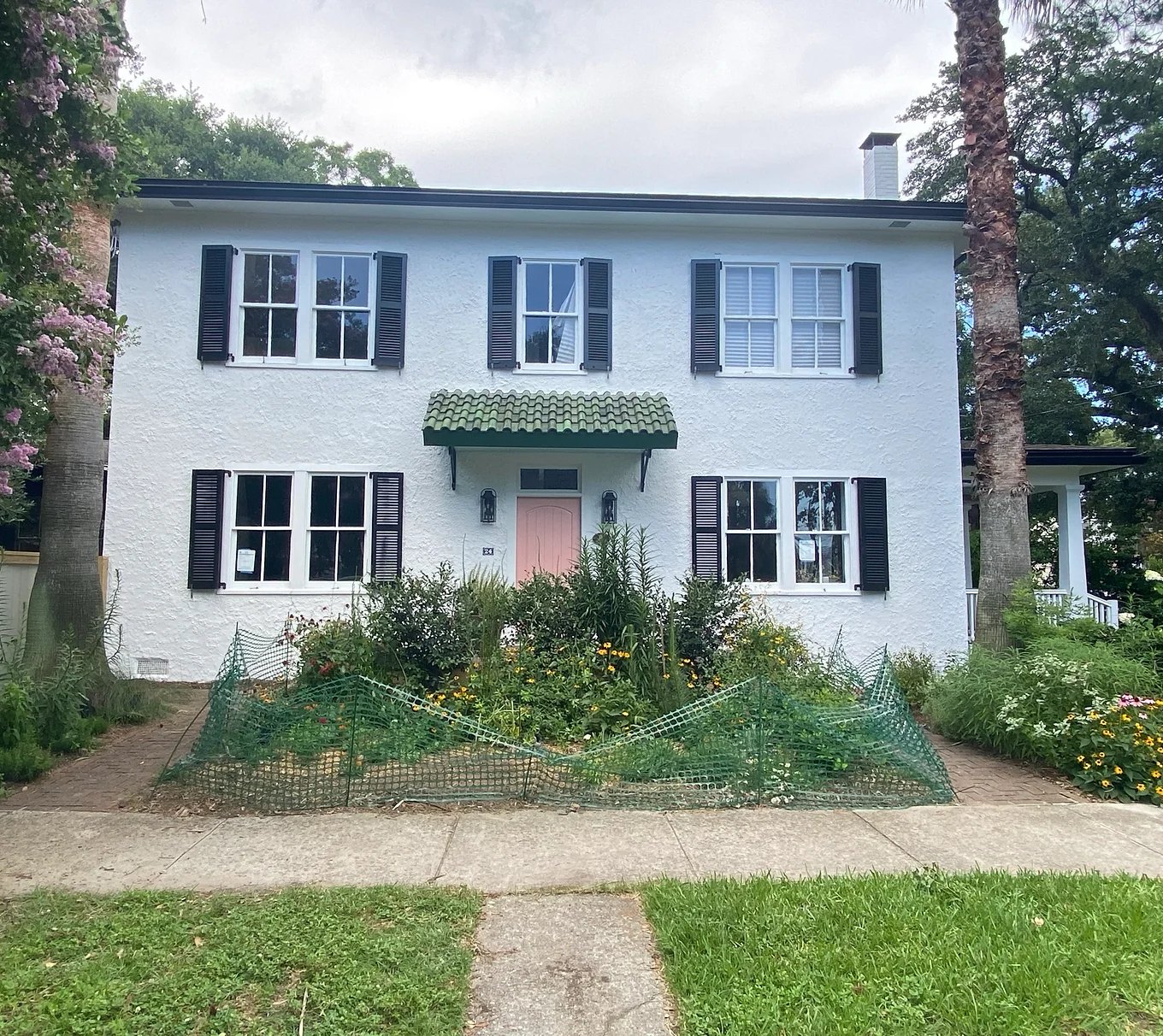
If your home was built before 1978, the cutoff year in the EPA’s lead-safe rule, this section applies to you. The EPA’s Renovation, Repair and Painting rule says firms performing renovation, repair and painting projects that disturb lead-based paint in homes built before 1978 must be EPA- or state-certified. The EPA’s 2026 FAQ sets the thresholds: more than six square feet of painted surface inside, or more than 20 square feet outside.
The rule also bans certain methods outright, including open-flame burning of painted surfaces, heat guns above 1,100°F and power sanding without HEPA shrouds. For a homeowner comparing estimates, that has two consequences. Lead-safe containment and cleanup take time and should appear in the scope, and a much lower price on an old house is worth a question about how the work will be done. The rule generally does not apply to homeowners working on their own homes.
South Carolina registration and your paperwork
In South Carolina, painting is one of the residential specialty contractor classifications. State law requires registration when a job exceeds $500, and SC LLR notes that no exam is required to become a registered specialty contractor. You can look a contractor up on the SC LLR licence lookup before you sign anything; the SC Department of Consumer Affairs also suggests getting at least three bids.
The Federal Trade Commission’s guidance on hiring a contractor is a good checklist for what a written estimate should contain: a description of the work, materials, completion date and price. Its contract guidance goes further and suggests listing materials with each product’s colour, model, size and brand. It also advises against paying the full amount up front. If your house sits in one of Charleston’s historic districts, add the City’s colour review to the plan; our post on haint blue and Charleston green covers what the Board of Architectural Review asks for.
“His pricing is very competitive and fair, and his workmanship is awesome.”Andy N, Palmetto client review
How to compare two or three estimates
Put the estimates next to each other and fill in this grid. Any blank is a question to ask before you decide, not a reason to assume the cheaper one is the better deal.
| Line up | Look for | Red flag |
|---|---|---|
| Surfaces | Every surface named: siding, trim, doors, shutters, ceilings, railings, rooms | “Exterior painting” with no list |
| Preparation | Washing, scraping, caulking, priming and repairs described | No mention of preparation at all |
| Products | Brand, product line, sheen and colour per surface | “Premium paint” with no name |
| Coats | How many coats on each surface | Coats not stated |
| Exclusions | Carpentry, permits, colour review, furniture moving | No exclusions listed anywhere |
| Lead-safe work | Certification and containment for pre-1978 homes | No answer when you ask |
| Schedule and payment | Start window, weather plan, deposit and final payment | Full payment up front |
Ten minutes of questions at the walkthrough
The estimate visit is the cheapest point in the whole project to remove a surprise. These are the questions that most often change a number, or explain why two numbers differ:
- Which surfaces are you pricing, and which are you leaving alone?
- What will you do about the peeling, cracked or soft spots you can see?
- Which product and sheen are you planning for each surface, and how many coats?
- How will you reach the high parts of the house, and where will equipment sit?
- If you find rot or damage once work starts, how will we agree the extra work?
- What do you need from us: furniture moved, gates open, vehicles out of the way?
- What deposit is due, when is the final payment, and what does the follow-up visit cover?
None of these are trick questions. A painter who has walked the house properly will answer them quickly, and the answers make your comparison grid fill itself in. If an answer changes the scope, ask for it in writing before you accept. When you are ready, the free quote form lets you list every surface you want considered so the first visit covers all of it.
One more honest point: the lowest estimate is sometimes the right one. If it lists the same surfaces, preparation, products and coats as the others, and the firm is registered and lead-safe certified where it needs to be, a lower number may simply reflect a smaller crew or a better-fitting schedule. The grid is there to tell you when that is true.
How a Palmetto estimate works
Palmetto’s published process starts with an onsite meeting with the owner, Greg Bores, to discuss every detail of the job, followed by a comprehensive estimate. On acceptance you get a welcome email that sets out timelines, deposit information, project details and colour choices, and Greg keeps you updated once work starts. After completion Greg follows up, and any touch-ups are handled at your convenience.
If you already have an estimate from someone else, bring it. Comparing like with like is the fastest way to a fair decision, and it is the conversation we would want to have if we were the homeowner.
Questions
How much does it cost to paint a house exterior?
Angi’s national average, updated July 2026, is $3,177, with most homeowners paying $1,819 to $4,551. A Charleston house can sit well outside that range depending on size, height, condition and the surfaces included.
How much does it cost to paint a house interior?
Angi’s national average, updated July 2026, is $2,022, within a full range of $350 to $5,800. The rooms, ceilings, trim and doors you include decide where your project lands.
Why are two painting estimates so different?
Usually because they cover different work: different surfaces, preparation, products, number of coats or exclusions. Line them up surface by surface before comparing totals.
Does a painter need a licence in South Carolina?
Painters are a residential specialty contractor classification and must register with SC LLR when a job exceeds $500. Look up the registration before you sign.
My house was built before 1978. Does that change anything?
Yes. Paid work that disturbs more than six square feet of paint inside or 20 square feet outside falls under the EPA lead-safe rule, which requires a certified firm and specific work practices.
Does Palmetto charge for an estimate?
No. Palmetto starts every project with a free quote and an onsite conversation with Greg Bores.
Sources
- Angi: Cost to paint a house exterior (updated 20 Jul 2026)
- Angi: Cost to paint a house interior (updated 9 Jul 2026)
- US EPA: Lead Renovation, Repair and Painting Program rules
- SC Code of Laws, Title 40 Chapter 59 (residential builders)
Also consulted: FTC “How to avoid a home improvement scam”; US EPA RRP FAQ (January 2026) and small entity guide (2026); SC LLR residential specialty contractor page; SC Department of Consumer Affairs consumer alert (December 2024); FTC “Hiring a Contractor”. Sources read 30 September 2026.
01 / Keep reading
More from the notebook.
Posts and guides for Lowcountry homeowners.

02 / Your next chapter
Tell us about the house.
A conversation, a free onsite estimate and a scope in writing. No pressure to decide on the spot.
843.998.1649 info@palmettopaintingcontractors.com