
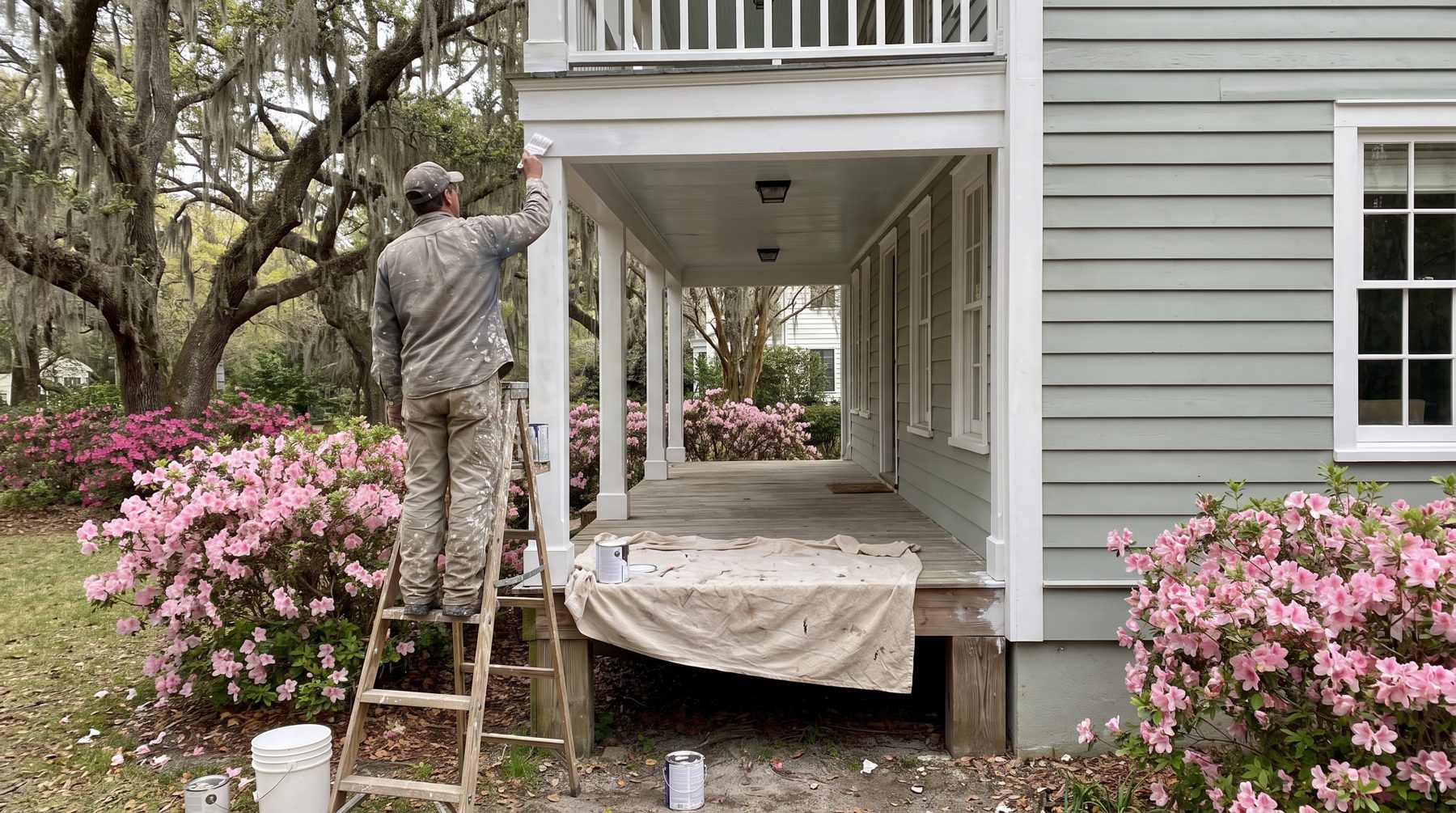
The best time to paint a house exterior in Charleston
Spring and fall are the easy answer. The useful answer is in the climate data and on the product data sheet: temperature, dew point, rain and the hours of sun on each side of the house.
- NOAA 1991 to 2020 normals
- Manufacturer application rules
- 8 minute read
Ask a Charleston painter when to paint the outside of a house and you will usually hear “spring or fall”. That is a fair rule of thumb, and the climate data backs it up. But it is not the whole story, because exterior paint does not care about the calendar. It cares about the temperature of the surface, how close the air is to its dew point, and whether rain is coming in the next few hours.
This post lays out Charleston’s weather month by month from NOAA’s official climate normals, then the conditions the paint manufacturers actually print on their data sheets, so you can see why the best weeks fall where they do and what a good crew does in the months between.
Key takeaways
- April and October are Charleston’s mildest months, with March, May and November close behind.
- June through September are the wettest months, and August averages almost seven inches of rain. Hurricane season runs 1 June to 30 November.
- Sherwin-Williams Emerald and Benjamin Moore Aura exterior data sheets allow application down to 35°F, but Sherwin-Williams’ consumer guide advises avoiding painting below 50°F or above 90°F.
- Keep the surface at least 5°F above the dew point, and avoid painting when rain is expected within two to three hours.
- Sherwin-Williams and the USDA both suggest an exterior repaint interval of roughly 7 to 10 years.
Charleston’s weather, month by month
NOAA’s National Centers for Environmental Information publish 30-year climate normals for Charleston International Airport. The 1991 to 2020 figures below are the official averages. The humidity column is our own calculation from NOAA’s hourly normals, so treat it as a guide rather than a published figure.
| Month | Avg high °F | Avg low °F | Rain (in) | Dew point °F | Rel. humidity |
|---|---|---|---|---|---|
| January | 60.2 | 38.9 | 3.37 | 38.7 | 67% |
| February | 63.8 | 41.6 | 3.05 | 40.9 | 67% |
| March | 70.1 | 47.3 | 3.35 | 45.8 | 65% |
| April | 77.1 | 54.5 | 3.29 | 53.5 | 67% |
| May | 83.6 | 63.0 | 3.32 | 62.0 | 71% |
| June | 88.5 | 70.4 | 6.21 | 69.6 | 75% |
| July | 91.3 | 73.7 | 6.60 | 72.9 | 77% |
| August | 89.8 | 73.1 | 6.97 | 72.6 | 78% |
| September | 85.4 | 68.3 | 6.01 | 67.9 | 78% |
| October | 77.9 | 57.7 | 4.33 | 58.5 | 75% |
| November | 69.4 | 47.1 | 2.66 | 48.3 | 72% |
| December | 62.7 | 41.6 | 3.35 | 42.6 | 72% |
Three patterns stand out. April and October sit in the sweet spot, with highs in the upper 70s and lows comfortably above 50°F. June through September carry more than six inches of rain a month, mostly in afternoon storms, with dew points near 70°F. And November is the driest month of the year at 2.66 inches, which makes it a quietly good month for exterior work as long as the mornings are not too cold. The annual total is 52.51 inches.
What the paint can says
Every exterior paint has an application window printed on its data sheet. The current Sherwin-Williams Emerald Exterior data sheet allows application down to 35°F and says the surface should be at least 5° above the dew point, and to avoid using it if rain or snow is expected within two to three hours. Benjamin Moore’s Aura Exterior data sheet gives a surface temperature range of 35°F to 100°F and notes that humidity slows drying.
| Condition | Sherwin-Williams Emerald Exterior | Benjamin Moore Aura Exterior |
|---|---|---|
| Minimum temperature | 35°F | 35°F surface |
| Maximum temperature and sun | Do not paint in direct sun (data sheet) | 100°F surface |
| Dew point and humidity | Surface at least 5° above dew point | High humidity slows drying |
| Rain | Avoid if rain is expected within 2 to 3 hours | Follow the data sheet for your product |
Here is the nuance. Sherwin-Williams’ own consumer guide to exterior painting is stricter than its data sheet: it advises avoiding painting when temperatures are below 50°F or above 90°F. Both statements are true. The data sheet describes what the product can tolerate; the consumer guide describes a comfortable margin. In Charleston that margin matters most at the two ends of the year, on January mornings that start near freezing and July and August afternoons near or above 90°F.
“Never paint immediately after a rain, when rain is predicted or during foggy weather.”Sherwin-Williams, Know Your Substrate
Season by season in the Lowcountry
Spring: March to May
The most popular window, and for good reason. Rain averages a little over three inches a month and dew points stay in the 40s and 50s until May. Spring pollen can settle on wet paint, which is worth planning around on the windiest days.
Summer: June to September
Painting continues, but the day changes shape. Crews start early, work the shady sides of the house in the afternoon, and stop well before the usual afternoon storms. The dew point is the hidden problem: on a humid evening a surface can cool to the dew point and collect moisture on paint that has not dried. The USDA Forest Products Laboratory’s long-standing advice is to follow the sun around the house and leave at least two hours for paint to dry before it cools to the point where condensation could occur. Hurricane season begins on 1 June; NOAA puts the peak of the Atlantic season on 10 September.
Fall: October to November
A strong window. October is as mild as April, and November is the driest month of the year. Shorter days mean an earlier finish so the last coat dries before evening dew. If you want the house done before the holidays, this is the season to aim for.
Winter: December to February
Possible on many days. Average highs sit in the low 60s, so mid-day work on sunny elevations is often within both the data sheet and the consumer guide’s 50°F margin. The risk is the morning low and the overnight drop, so winter work is planned around the forecast, a day at a time.
A painting-day weather checklist
Whatever the month, the decision is made the evening before and again that morning. These are the checks that matter, all drawn from the manufacturer and government guidance above:
- Rain window. No rain expected within two to three hours of application, per the Emerald data sheet, and longer is better in summer.
- Dew point. The surface at least 5°F above the dew point. On humid mornings, wait for the dew to burn off before starting a wall.
- Temperature band. Inside the product’s range, and ideally inside Sherwin-Williams’ consumer margin of 50°F to 90°F.
- Sun on the wall. The Emerald data sheet says do not paint in direct sun; follow the sun around the house instead of chasing it.
- Time before evening. At least two hours for the film to dry before it cools toward condensation, per the USDA.
- Dry surfaces. After a wash or heavy rain, a dry surface first. Sherwin-Williams advises at least 24 to 48 hours after washing.
- Tropical forecasts. From June to November, a named storm in the forecast moves the schedule, not the other way round.
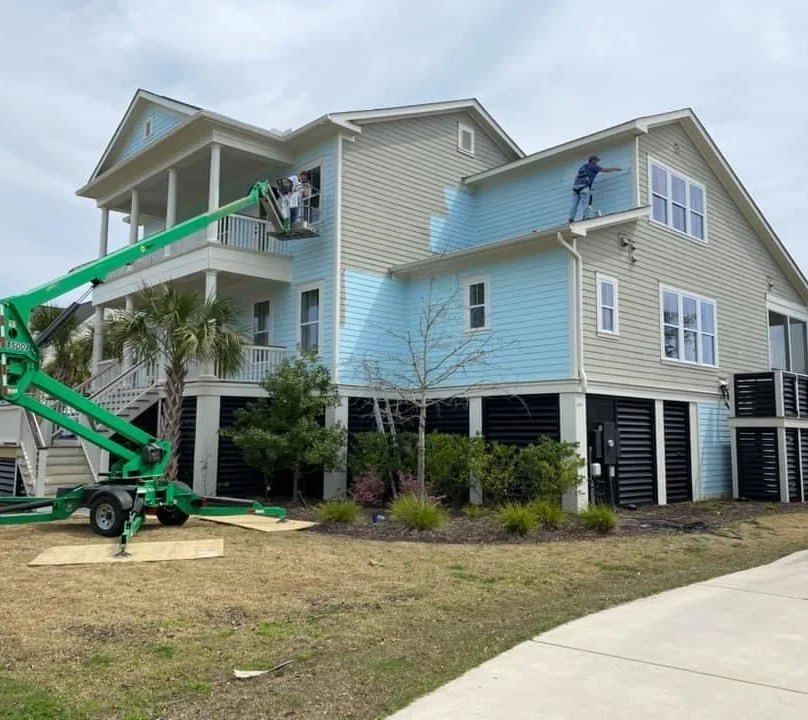
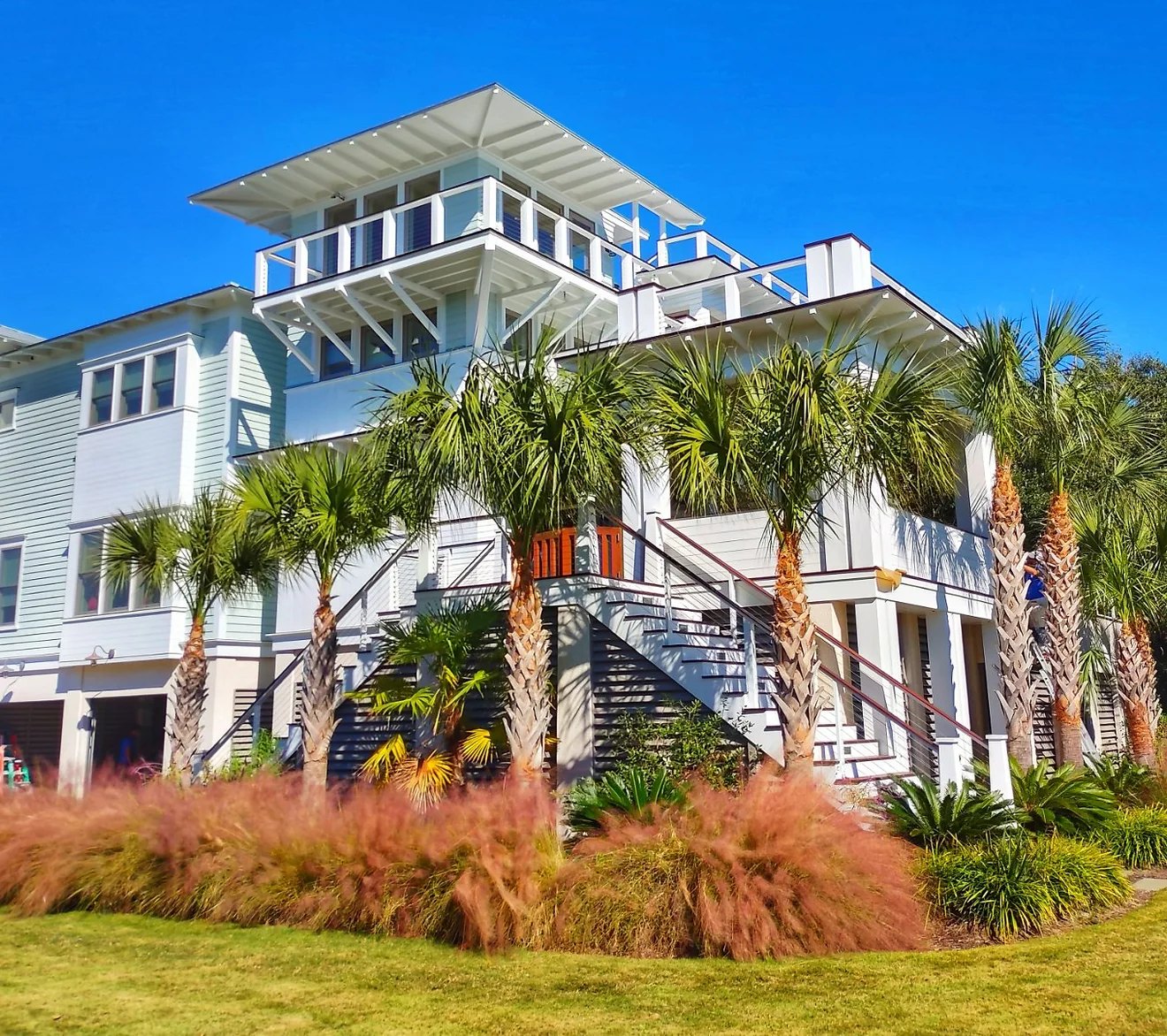
A practical way to use the list is by elevation. East walls get morning sun and are usually dry first; west walls are best left until the sun has moved off them. On a raised beachfront house like Coastal Retreat, that can mean working around the house in a different order on different days.
How long an exterior paint job lasts here
Sherwin-Williams’ exterior how-to says repainting is typically needed every 7 to 10 years. The USDA Forest Products Laboratory’s handbook gives a similar paint-maintenance range of 7 to 10 years for top-quality acrylic latex topcoats. Salt air, full sun on south and west walls and mildew in shaded, damp corners all shorten that on the coast, which is why a mid-life wash and touch-up is worth doing. Our post on soft washing versus pressure washing covers how to clean a house before it is repainted.
Planning your repaint with Palmetto
Palmetto’s welcome email sets out the timeline before work starts, and Greg stays in touch from acceptance to project start, so a weather change becomes a conversation rather than a surprise. If you are aiming for spring or fall, the best time to call is a season ahead. Our exterior repaint planning guide will help you get the scope ready while you wait.
Questions
What is the best month to paint a house exterior in Charleston?
April and October are the mildest months in NOAA’s 1991 to 2020 normals, with highs in the upper 70s. March, May and November are close behind, and November is the driest month of the year.
Can you paint outside in a Charleston summer?
Yes, with early starts, work on the shaded sides of the house and a stop before afternoon storms. The paint must also dry before evening dew, so the last coat of the day goes on early.
How cold is too cold to paint outside?
Sherwin-Williams Emerald and Benjamin Moore Aura data sheets allow application down to 35°F, while Sherwin-Williams’ consumer guide advises avoiding painting below 50°F. Check the specific product and the overnight low.
How long after rain can you paint outside?
The surface must be dry. Sherwin-Williams says never to paint immediately after rain, when rain is predicted or in fog, and its Emerald data sheet advises avoiding application if rain is expected within two to three hours.
How often should a Charleston house be repainted?
Sherwin-Williams and USDA guidance both point to roughly 7 to 10 years for a good-quality exterior system. Sun, salt air and mildew can shorten that, so inspect and wash between repaints.
Sources
- NOAA NCEI: 1991 to 2020 monthly normals, Charleston Intl Airport
- Sherwin-Williams: Emerald Exterior product data sheet
- Benjamin Moore: Aura Exterior technical data sheet
- Sherwin-Williams: Exterior painting how-tos
Also consulted: NOAA tropical cyclone climatology; USDA Forest Products Laboratory, Agriculture Handbook 647 (1986); Sherwin-Williams “Know Your Substrate” pro tips. Relative humidity is derived from NOAA hourly normals. Sources read 30 September 2026.
01 / Keep reading
More from the notebook.
Posts and guides for Lowcountry homeowners.

02 / Your next chapter
Tell us about the house.
A conversation, a free onsite estimate and a scope in writing. No pressure to decide on the spot.
843.998.1649 info@palmettopaintingcontractors.com