
Owning a home in Charleston and Charlotte: how painting and remodeling differ
Paint fails differently in the two markets: Charleston wears it with salt, sun and constant dampness, while Charlotte stresses it with freezing nights and slow-draining clay. That changes the prep, the hardware, the inspection routine and the questions worth asking a contractor.
- NOAA numbers for both cities
- Sources linked
- 7 minute read
Plenty of owners now hold a house in the Lowcountry and another near Charlotte, or are selling one to buy the other. Each house asks for different things, and advice that is right in one market quietly goes wrong in the other.
This post compares the two using public sources: NOAA, manufacturer technical pages, FEMA, and research from NC State and Clemson. It gives no prices or repaint intervals; no public source supports one number for both markets. Palmetto Painting Contractors serves the Charleston area, so the Charlotte side is covered only enough to ask good questions.
Key takeaways
- Charlotte averages about 36 more freezing nights a year than Charleston; Charleston averages about 15 more days at or above 90°F (NOAA, 1991 to 2020).
- Near the coast the first job is washing off salt, and FEMA documents salt corrosion of metal hardware 5 to 10 miles inland.
- In the Piedmont, NC State says clay subsoil moves water slowly, so grade and downspouts decide whether paint survives.
- Rules differ: NC requires a general contractor license from $40,000 and ignores other states’ licenses; SC registers painters above $500.
- Charlotte’s historic districts do not regulate paint color; Charleston reviews color changes.
The weather numbers, side by side
NOAA’s 1991 to 2020 climate normals, read on 27 October 2026, give the cleanest comparison. Both stations are airports, so a house on a barrier island or a hilltop will differ, but the gap between the cities is large.
| Annual normal | Charleston, SC | Charlotte, NC |
|---|---|---|
| Days with a low at or below 32°F | 22.4 | 58.3 |
| Days with a high at or above 90°F | 64.3 | 49.2 |
| Precipitation (inches) | 52.51 | 43.60 |
| Snowfall (inches) | 0.3 | 3.5 |
Read this as a split in stresses, not a ranking. Charleston’s heat and rain keep paint and wood warm and damp for more of the year. Charlotte’s freezing nights cut the days when caulking and painting are possible: a Sherwin-Williams sealant data sheet dated June 2014 says to apply only above 40°F and never to frozen or frost-covered surfaces, and to allow extra dry time in high humidity.
Salt air: what changes at the coast
Salt is the stressor the Charlotte area does not have. Sherwin-Williams’ exterior product selection FAQ says acrylic latex paints hold up at the seashore, then adds that for the best performance you should carefully wash away any salt deposits and chalk, and prime bare wood. That is a prep instruction rather than a product upgrade.
Metal is where salt costs the most. FEMA’s Technical Bulletin 8, dated June 2019, says salt spray falls off quickly over the first 300 to 3,000 feet inland, yet studies have shown accelerated corrosion as far as 5 to 10 miles inland. Simpson Strong-Tie’s guidance, read on 27 October 2026, says locations up to 10 miles from the ocean can be considered at risk. Ask what the railings, hinges and fasteners are made of before anyone paints over them.
Dampness and mildew: the Lowcountry record
Clemson researchers Linda Gardner and Craig De Witt reported in 1992 on a January 1989 survey of homeowners in 16 South Carolina counties. Of 1,329 usable forms, 69% reported a moisture problem, and mildew on exterior siding or walls was among the most frequent symptoms. The survey is old and statewide, but it shows what a humid climate does to houses.
Sherwin-Williams’ surface preparation page says up to 80% of coatings failures trace to inadequate preparation, and lists mildew among the contaminants to remove. The useful follow-up is why the mildew is there.
Clay and drainage: the Piedmont side
NC State Extension’s guidance on soil around homes, published 22 April 2024, says much of the Piedmont subsoil is high in clay, that such soils tend to move water slowly and may stay wet for long periods, and that construction compaction slows it further. It contrasts that with the sandy “light” soils of the coastal plain, which allow better water movement.
For paint, the point is where the water goes. NC State’s Mold and Moisture Checklist, published 4 April 2022, says to confirm the ground slopes away from the house, downspouts extend 6 to 10 feet from the foundation, and siding and exterior paint show no peeling or bubbling. Benjamin Moore says wood should be below 15% moisture content before painting and that peeling paint needs its cause found and corrected. Repainting a wall that keeps getting wet repaints the failure.
Side by side: prep, hardware, review and licensing
| Topic | Lowcountry (Charleston area) | Charlotte area |
|---|---|---|
| First prep question | Salt and mildew: wash both off (Sherwin-Williams) | Water: check grade and downspouts (NC State Extension) |
| Metal and fasteners | Salt corrosion risk reaches 5 to 10 miles inland (FEMA) | No sea-salt zone; rust is a normal prep item |
| Caulk and sealant | Allow extra dry time in humidity (Sherwin-Williams) | Above 40°F, never on frost (same data sheet) |
| Historic review | City review of color; Category 1 and 2 buildings go to the full Board (City of Charleston, 2024) | Color not regulated; painting unpainted brick typically not allowed (Charlotte HDC) |
| Contractor license | SC: painters register above $500 (S.C. Code 40-59-20) | NC: general contractor license from $40,000; other states’ licenses not recognized (NCLBGC) |
| Lead-safe rule, pre-1978 homes | SC follows the EPA program (EPA) | NC runs its own EPA-authorized program (EPA) |
Maintenance cycles: inspect to the climate, not the calendar
No source we found gives one repaint interval that holds in both markets, and a number without a house, an exposure and a named product is a guess. Public sources do support regular inspection, as in NC State’s checklist. This routine is planning advice, not a manufacturer requirement.
- Lowcountry house. After the hot, wet months, check shaded walls, porch ceilings and eaves for mildew and chalk, and railings and fasteners for rust staining. Wash salt off before touch-ups.
- Charlotte-area house. After winter, check caulk joints, hairline cracks and the lowest courses of siding, then watch where the downspouts send the first heavy rain.
- Either house. Photograph and date what you find, and keep the written scope from the last paint job.
Remodeling: changing a house changes its moisture balance
Remodeling follows the same split, with one lesson from the Clemson survey. Houses altered after construction were among the variables significantly linked to moisture problems, and the changes most associated with trouble altered soil levels or drainage, shifted heating, cooling and ventilation, or used finishes with a different vapor permeability. A new bathroom, an added room or new siding changes how a house handles water.
The EPA says to use exhaust fans in bathrooms and kitchens to move moisture outdoors, and that moisture solutions differ by climate. Paint is the last trade in most remodels, so ask who owns the fan, the finish and the paint as one scope. Interior painting is where Palmetto covers that last step on the Charleston side.
If the Charlotte house needs remodeling that ends in paint, one local option is Chris’ Painting & Remodeling, a Monroe, NC painting and remodeling contractor that started in fall 2000. Its page on home remodeling in Charlotte, NC lists kitchens, bathrooms, beams, stairs, tile, flooring, basements and bonus rooms, with the paint at the end done by the same crew, and says it works in Charlotte and about fifty miles around it.
If you are selling one of the two
Order matters more than color: fix the water, then paint. A fresh coat over an unresolved water problem is paint applied to the symptom.
For any house built before 1978, EPA’s disclosure rule requires that buyers receive known information about lead-based paint before signing a contract, and gives them the chance to order an independent inspection (EPA, read 27 October 2026). That applies in both states. Keep paint paperwork in one folder: product names, colors, dates and the contractor’s license details.
What to ask any contractor, in either market
- Which license or registration covers this job, in this state? Look up the number. The NC board says it does not recognize other states’ licenses.
- What is making the surface wet, and who fixes that first? Grade, downspouts, flashing and ventilation come before paint.
- How will the surface be prepared? Salt and mildew at the coast; loose paint, caulk joints and moisture content in the Piedmont.
- What are the fasteners and hardware made of? This matters most near the coast, and FEMA documents corrosion 5 to 10 miles inland.
- Which products, by name and color, and what do their data sheets say about temperature? Write them into the scope.
- Was the house built before 1978, and is the firm certified for lead-safe work under the program that applies in this state?
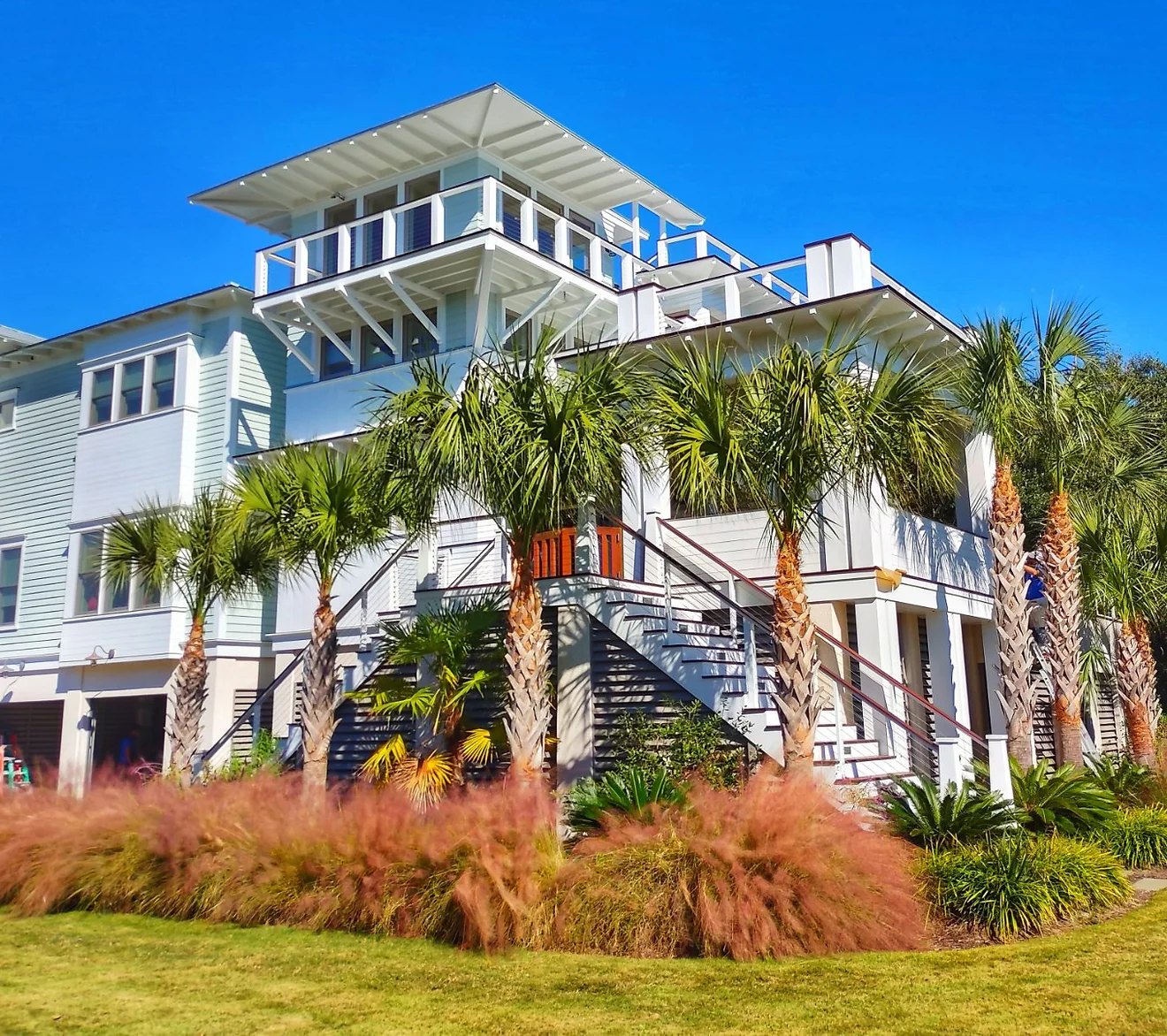
Where to start on the Charleston side
Palmetto is owner-operated by Greg Bores and serves the Charleston area; the Charleston area page lists where. For the Lowcountry exterior process, the guide to planning an exterior repaint ends with a checklist to bring to an estimate. In either market, collect more than one estimate and compare the scopes, not only the totals.
Questions
Does salt air really change how a house is painted?
Mostly in the prep. Sherwin-Williams advises washing away salt deposits and chalk and priming bare wood, and FEMA documents corrosion of metal hardware 5 to 10 miles inland, so fasteners and railings matter as much as the paint.
Do freezing nights matter if I only paint in spring and fall?
For scheduling, yes. NOAA’s 1991 to 2020 normals show about 58 nights a year at or below 32°F at Charlotte Douglas Airport against about 22 at Charleston International, and a Sherwin-Williams sealant data sheet says to caulk only above 40°F.
Can one contractor handle both of my houses?
Only if the contractor meets each state’s rules. North Carolina’s general contractor board says it does not recognize licenses from other states, and South Carolina registers painters as residential specialty contractors above $500.
Do paint color rules differ between Charleston and Charlotte?
They can. Charleston’s guidelines say Category 1 and 2 buildings go before the Board for any color change. Charlotte’s historic district standards say color is not regulated, but painting unpainted brick is typically not allowed.
Sources
- NOAA NCEI: 1991 to 2020 annual normals, Charleston International Airport (USW00013880)
- NOAA NCEI: 1991 to 2020 annual normals, Charlotte Douglas Airport (USW00013881)
- Sherwin-Williams: exterior product selection FAQs
- Sherwin-Williams: surface preparation
- Sherwin-Williams: Sher-MAX urethanized elastomeric sealant data sheet (June 2014)
- Benjamin Moore: how to paint your home exterior
- FEMA: NFIP Technical Bulletin 8, corrosion protection for metal connectors and fasteners in coastal areas (June 2019)
- Simpson Strong-Tie: stainless-steel connector solutions
- Gardner and De Witt, Clemson University: Moisture damage in South Carolina housing, Building Research and Information 20(3), 1992
- NC State Extension: Modifying Soil for Plant Growth around Your Home (22 April 2024)
- NC State Extension: Mold and Moisture Checklist (4 April 2022)
- US EPA: what are the main ways to control moisture in your home?
- US EPA: Lead Renovation, Repair and Painting Program (17 June 2026)
- US EPA: lead-based paint laws and regulations (disclosure rule)
- NC Licensing Board for General Contractors: September 2023 board brief ($40,000 threshold)
- NC Licensing Board for General Contractors: hiring guidance (3 June 2025)
- South Carolina Code of Laws, Title 40, Chapter 59, section 40-59-20
- City of Charleston: Board of Architectural Review general guidelines (2024)
- City of Charlotte: Historic District Design Standards
Sources were read on 27 October 2026. Both NOAA stations are airports; a house near the water or on a hill will differ. The planning advice in this post is general and not a specification.

Free painting quotes in Charleston and Mount PleasantTell us about the house.
A conversation, a free onsite estimate and a scope in writing. No pressure to decide on the spot.
843.998.1649 info@palmettopaintingcontractors.com